 Mark Zhong
China Supply Chain Field Notes · Consumer Electronics
Guangdong consumer electronics is not a one-city supply chain.
Shenzhen, Dongguan and Huizhou all contain technology and manufacturing capabilities. Their relative strengths—and their roles in a particular product—can differ substantially.
For an overseas buyer, the important question is not simply “Which city is best?” It is who controls the product, who performs each operation, which legal entity signs the contract, and who ultimately receives the money.
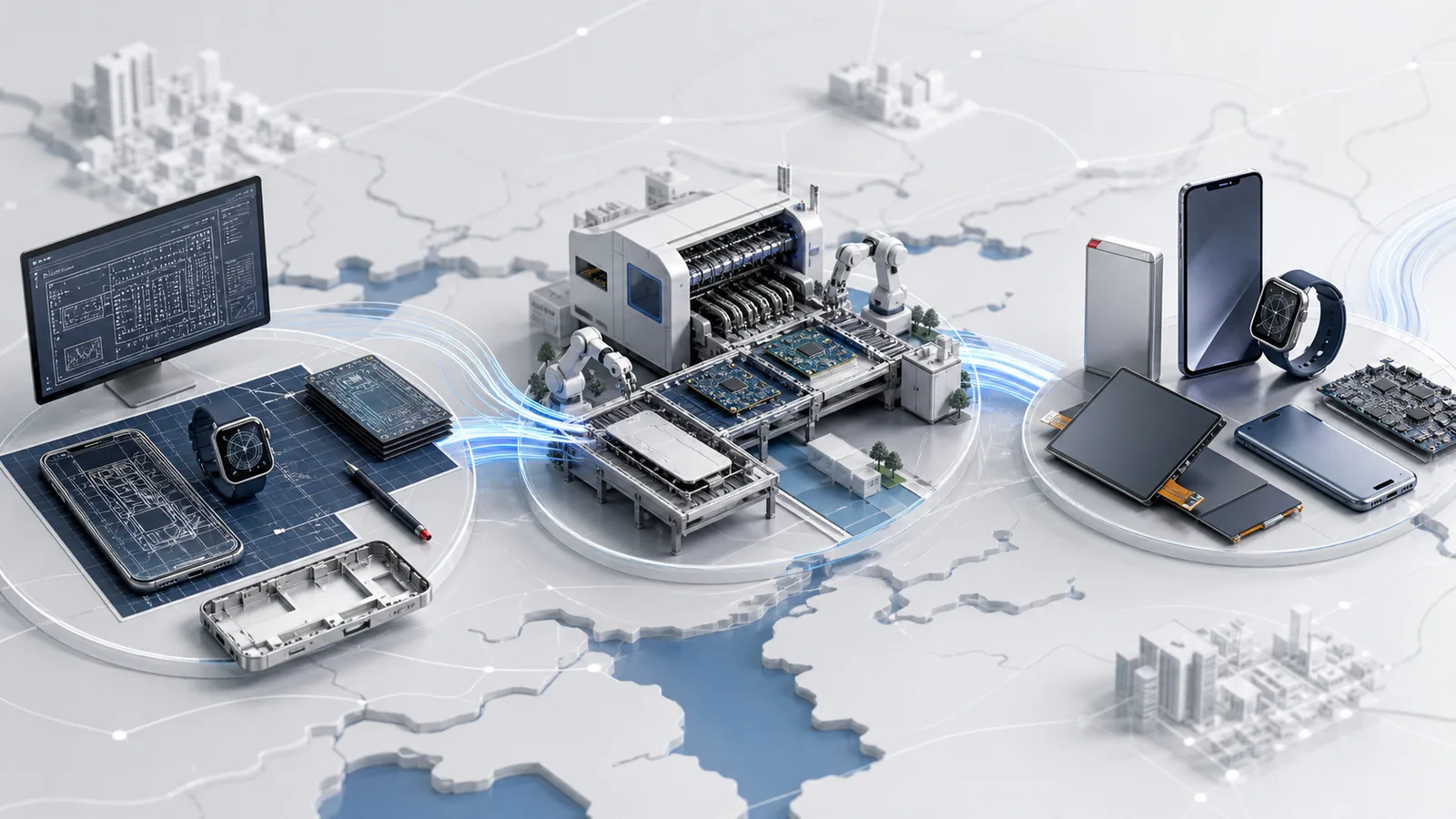
Why “made in Shenzhen” is often an incomplete description
Shenzhen is globally associated with electronics, but a Shenzhen address does not establish where a product is engineered, tooled, assembled or tested. A company may conduct product management and sales in Shenzhen while using manufacturers or specialist suppliers elsewhere in the Pearl River Delta. Another Shenzhen company may operate its own high-end manufacturing. The address alone cannot tell you which model applies.
Guangdong’s official industrial policy describes a broader electronics corridor along the eastern bank of the Pearl River. It covers communications equipment, smartphones and smart terminals, semiconductor components, sensors, displays and related applications. Guangzhou, Shenzhen, Dongguan, Huizhou, Heyuan and other cities participate in this system; this article focuses on Shenzhen, Dongguan and Huizhou because they provide a useful lens for understanding cross-city product development and manufacturing.
Shenzhen
Product definition, technology integration and supply-chain coordination
Shenzhen’s official smart-terminal plan covers smartphones, personal computers, tablets, VR and AR devices, wearables, connected vehicles, smart appliances and AIoT products. It also assigns different functions across the city: brand operations and ecosystem development in Futian; R&D and design in Luohu; source innovation and high-end manufacturing in Nanshan; smart manufacturing and broader terminal products in Bao’an and Longhua; major electronics-cluster capacity in Longgang; and high-end manufacturing and core components in Pingshan.
This supports a more precise conclusion than “Shenzhen is where electronics are made.” Shenzhen plays a particularly strong role in product definition, R&D, technology integration, brand operations and supply-chain coordination. It also contains substantial manufacturing, so it should not be described as an office-only or design-only city.
For buyers, a Shenzhen company may be a brand owner, design house, solution provider, trading company, contract manufacturer—or a business combining several roles. Identify what it controls directly and what it coordinates through other companies.
Dongguan
Smart terminals, precision production and scaled manufacturing
Dongguan’s smart mobile terminal cluster is officially recognized as a national advanced manufacturing cluster. The city reported RMB 947.02 billion in output from above-designated-size electronics and information manufacturers in 2022, including 196 million smartphones. Its development plan extends beyond final assembly to semiconductors, new displays, advanced materials, energy technologies and intelligent production equipment.
Major areas include Songshan Lake, Binhaiwan, Chang’an and Tangxia. The wider manufacturing environment can connect finished-device production with tooling, precision enclosures, optical parts, display components, miniature motors, automation and testing resources.
That depth makes Dongguan important for scaled production, but it is not a guarantee that every local supplier has low costs, stable quality or sufficient capacity. Those conditions must be evaluated for the specific company, facility, product and production period.
Huizhou
Display-related products, smart terminals and batteries
Huizhou should not be treated merely as lower-cost capacity spilling out of Shenzhen or Dongguan. Official city reporting identifies five major electronics-related areas: ultra-high-definition displays, 5G and smart terminals, intelligent connected vehicles, new-energy batteries and core basic electronics. Its electronics and information cluster exceeded RMB 500 billion in output in 2022.
Provincial planning also identifies Huizhou with televisions, monitors, tablets, set-top boxes, Wi-Fi 6 routers, VR and AR products, and wearables. This gives the city an independent role in Guangdong’s electronics geography, particularly around display-related terminals, smart products and batteries.
It would still be too broad to assume that any Huizhou supplier controls a complete display or battery value chain. Buyers must identify the precise component, process and legal entity involved.
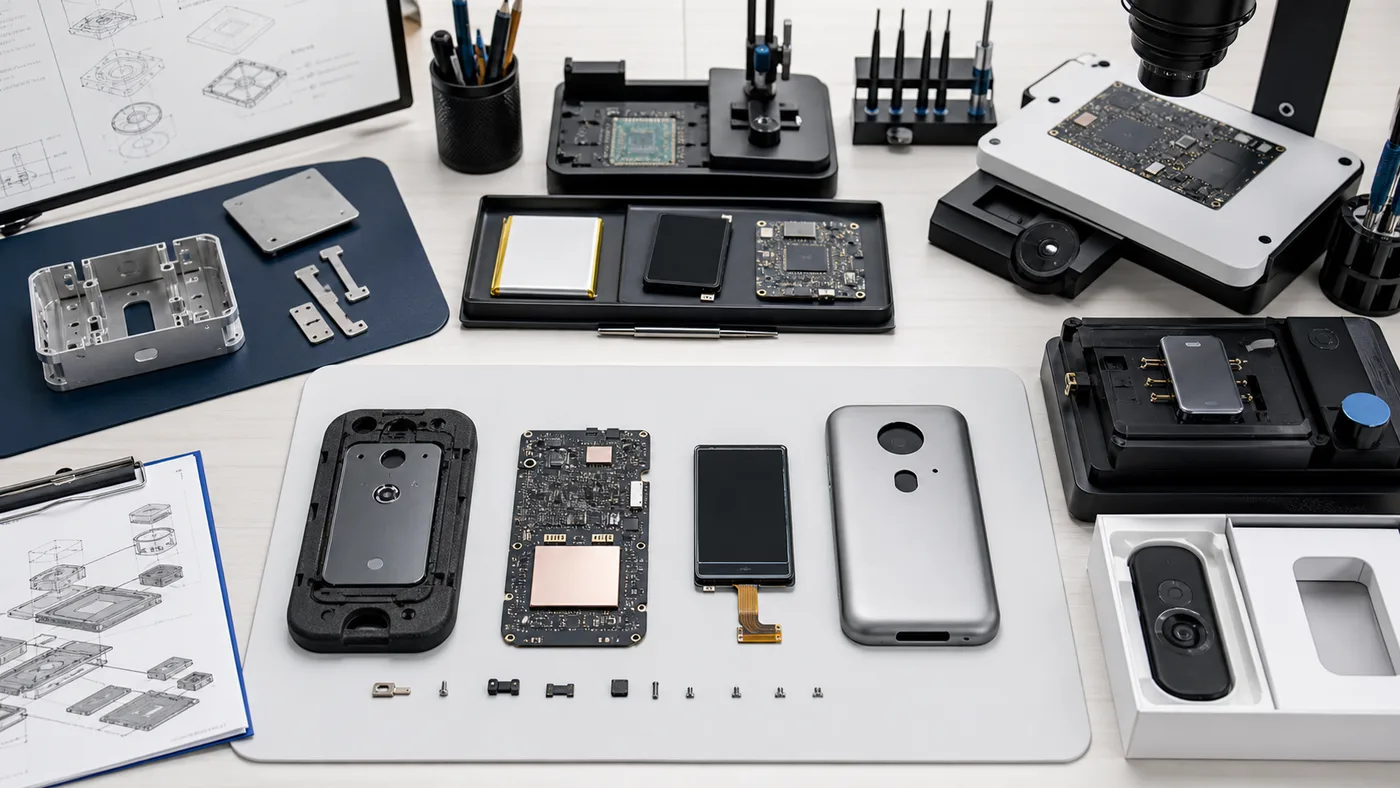
One product may involve several companies
A consumer electronics project can cross company and city boundaries. The following is an explanatory model, not a fixed production formula:
Five mistakes overseas buyers make
- Treating an office address as a factory address. Verify the legal entity and the operating company at the claimed production site.
- Assuming the seller performs every process. Ask which operations are in-house and which are subcontracted.
- Confusing a sample with production evidence. A sample does not establish R&D ownership, tooling control, approved materials or repeatable capacity.
- Ignoring version and material control. Confirm the BOM, firmware, test standard and approval process for substitutions.
- Failing to reconcile company identities. The brand, solution provider, manufacturer, exporter and beneficiary may be different entities. Their relationships should be documented.
Know which type of company you are dealing with
Brand owner
Controls the market identity and product proposition, but may outsource all manufacturing.
Design or solution provider
Supplies hardware, software, firmware, a reference design or a complete product solution. It may not operate the final production line.
Trading company
Coordinates customers, sourcing or export activity. It may add real value, but its role should not be confused with factory ownership.
Contract manufacturer
Builds to an agreed specification. Confirm ownership of designs and tooling, control of key materials, subcontracting and change procedures.
Factory or specialist processor
May control one or several production stages while outsourcing PCB assembly, finishing, display, battery, testing or other operations.
Exporter or payment entity
May be different from the brand, solution provider or manufacturer. Understand the legal and commercial relationship before transferring funds.
Questions to answer before a prototype
- Who defines the product architecture and writes the technical specification?
- Who develops the PCB, firmware and application software?
- Who owns the original design files and source materials?
- Which company physically produces the sample?
- Does the sample use intended production materials or temporary substitutes?
- Will the same company be responsible for mass production?
Questions to answer before tooling and production
- Which legal entity signs the tooling and manufacturing agreements?
- Who owns the tooling, and where will it be stored?
- Which operations are performed in-house and which are subcontracted?
- Is the bill of materials locked, and who can approve a substitution?
- Which test methods, tolerances and acceptance criteria apply?
- How will product versions, firmware and traceability be controlled?
Questions to answer before payment
- What is the full registered Chinese name of the contracting company?
- What is the relationship between the contracting and manufacturing entities?
- Does the beneficiary belong to the contracting company?
- If a related company or Hong Kong entity receives payment, is the relationship documented?
- Do the contract, invoice, export documents and beneficiary details make commercial sense together?
- Who receives development fees, tooling fees and production payments?
The regional map is only the beginning
Knowing where an industry concentrates can improve a search. It cannot replace verification of the company, facility, product capability, intellectual property, compliance documents and payment path behind a particular deal.
Request China-Side ResearchSources and limitations
- Guangdong Provincial People’s Government: strategic industrial cluster policy
- Guangdong policy interpretation: next-generation electronics cluster action plan
- Shenzhen smart terminal industry cluster action plan
- Dongguan smart mobile terminal advanced manufacturing cluster plan
- Huizhou Development and Reform Bureau: electronics cluster overview
- Guangdong manufacturing development plan
Statistics retain the year stated by the relevant public source. Regional policy and industry data do not constitute a recommendation or verification of any individual company. Last reviewed: 2 September 2026.